

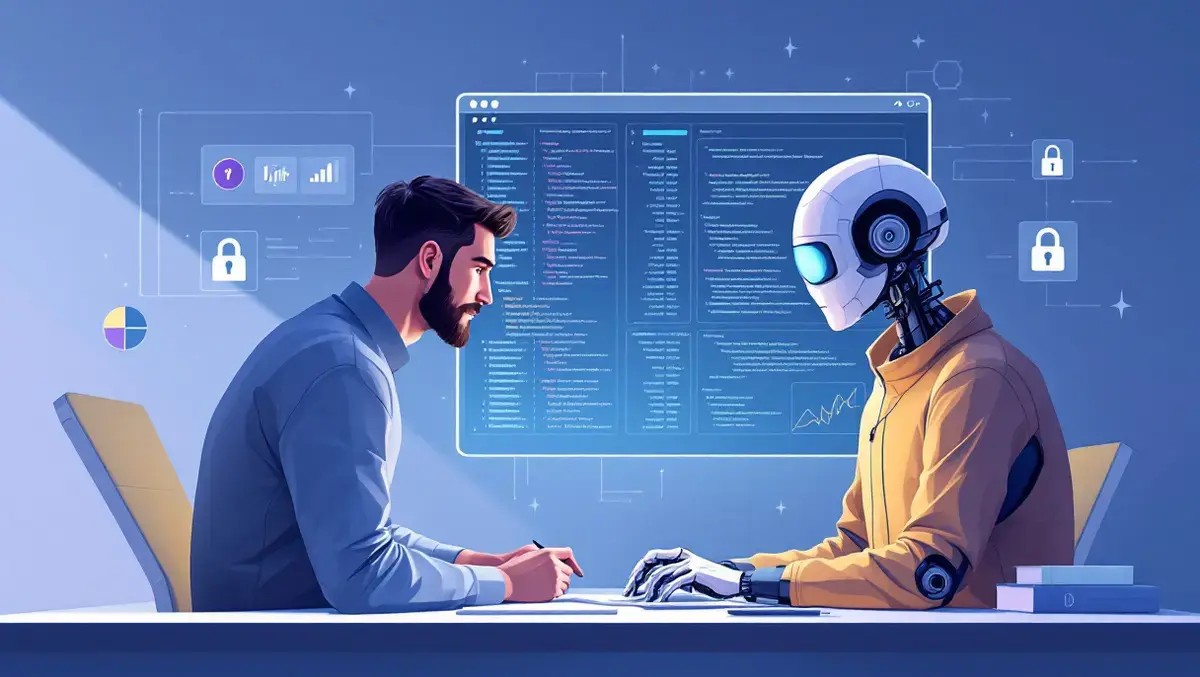
AI pentesting agents still lag behind human experts
Mon, 23rd Nov 2026 (Today)
NetSPI and Synack have published research on the performance of AI agents in penetration testing. The study found that none of the tested agent configurations consistently matched human penetration testers when working alone.
The findings come as investors assess cyber risk disclosures by newly listed AI companies, including warnings that theft of model weights or weaknesses in safeguards could undermine their commercial advantage.
The report examined 22 AI agent configurations across five web applications and compared the results with 425 human assessments reviewed by instructors. The work was designed to test whether AI agents could carry out penetration testing at a level comparable with human practitioners.
The research found that AI agents did identify some issues human testers missed. Even so, the strongest results came when human experts worked alongside the tools rather than relying on them independently.
Across every application reviewed, a pairing of a human tester and an AI agent found more issues than either working alone. In one public application, experts and agents each found 23 of 26 known issue types, while the combined effort found all 26.
Another example involved Sara AI Pentesting, which identified 62% of known issue types in one run on a public application. That rate rose to 88% when the same system was paired with human experts.
Coverage gap
The study also pointed to a persistent gap between AI-only testing and human-led work as tasks became harder. Human testers outperformed open-source agent setups by an average of 23 percentage points across all difficulty levels.
The gap widened as issue complexity increased, with a lead of 22 percentage points on easier issues and 30 percentage points on moderate ones.
Improvements in models and supporting harnesses helped results but did not eliminate the shortfall. The best-performing model in the test, with what the report described as optimal harness support, detected 44% of known issues, compared with a 49% baseline for entry-level human pentesters.
In the study, harnesses were used to provide tools, context and a testing process for the models. Changing harnesses could focus a model's work, but did not give it new penetration testing skills.
Noise problem
The researchers also highlighted a trade-off between higher output and higher noise. In one proprietary application, an AI agent with source code access found eight of nine known issues, but in static testing the same approach produced 87 findings against 32 known issues.
That left 55 extra reports requiring human validation. For security teams, the result suggests that a larger volume of alerts does not necessarily translate into more useful testing without expert review.
Methodology was central to the study's argument. Between May and August 2026, the companies tested frontier and open-source models across multiple agent harnesses, as well as Sara AI Pentesting, against five web applications, including two proprietary systems whose vulnerabilities were not publicly available.
Each application had a curated list of known vulnerabilities and defined evidence requirements. Every AI finding was scored against that list and then compared with a human baseline drawn from 425 instructor-reviewed assessments completed by 88 pentesters in seven classes of the companies' training programme.
Dr Mark Kuhr, Chief Technology Officer at NetSPI and Synack, said the results challenged assumptions formed from more limited public demonstrations. "Too much of the confidence in AI-only pentesting rests on demos and benchmarks run against public labs," he said. "We tested agents on a mix of public applications and ones they'd never seen, then scored them against trained human testers. While the agents caught vulnerabilities our experts rarely report, the research shows the strongest results come from experts paired with AI."
The report positions AI as a tool for repetitive exploration and evidence collection, while leaving judgement, validation and the linking of findings into attack paths to people. That division of labour has become a central issue for companies facing increased scrutiny over cyber controls, incident reporting and the resilience of AI systems.
Will Strei, Vice-President of AI Transformation at NetSPI and Synack, said organisations should not treat automation as a substitute for specialist oversight. "Security teams should view AI as another tool in the toolbox," he said. "AI can automate work, but automation without the guidance of human testers is an incomplete solution. Insourcing pentesting rarely works, because few teams can staff the expertise needed to direct AI agents for optimal outcomes. Whether you want to achieve continuous testing or match the capabilities of AI-enabled attackers, experts remain a critical resource for managing agents and devising a complete solution."