

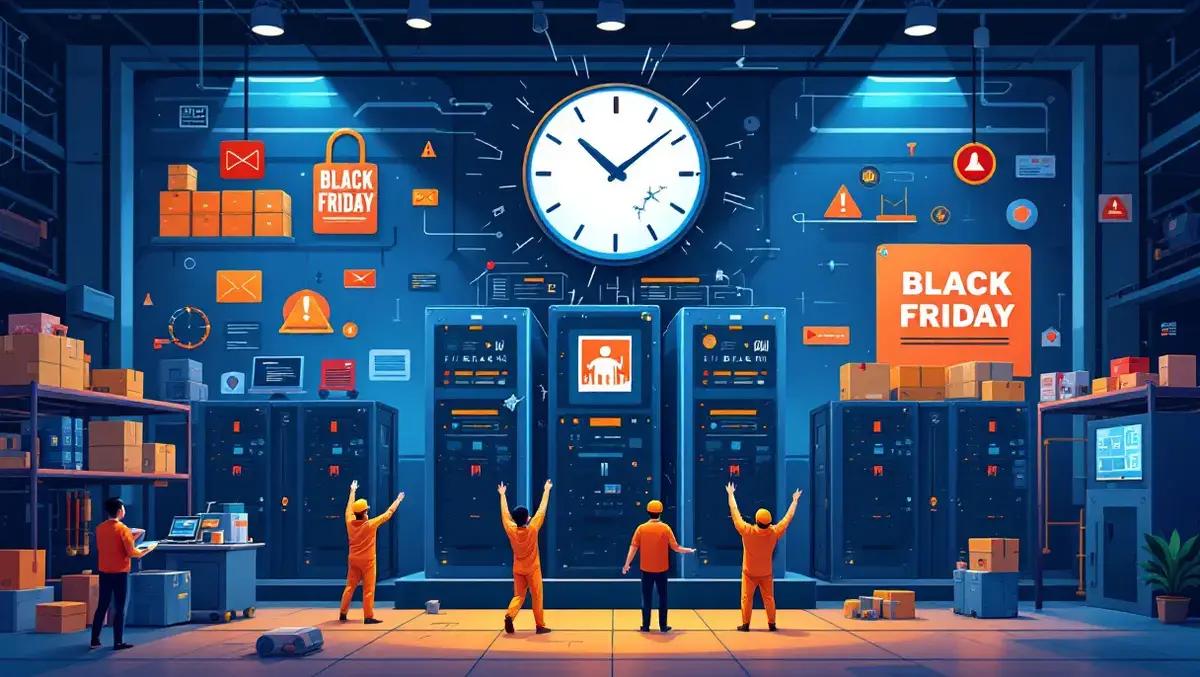
Black Friday retailers face faster AI-driven cyberattacks
Wed, 25th Nov 2026 (Today)
Insight UK has warned that retailers face faster cyberattacks during the Black Friday shopping period, with artificial intelligence shrinking the time available to fix vulnerabilities.
Rob O'Connor, Senior Cybersecurity Advisor in the Office of the CISO at Insight UK, said attackers are not relying on entirely new methods. Instead, they are using AI to move more quickly from discovery to exploitation. He said this is increasing pressure on security teams as retailers handle high volumes of online orders, payments and deliveries.
"The biggest difference this Black Friday is the speed of attacks. We're not necessarily seeing new types of cyber threats, but AI is making it faster and cheaper for attackers to identify vulnerabilities, develop exploits and launch attacks at scale.
This is significantly reducing the time defenders have to respond. In 2025, organisations had an average of 21.5 days to address a vulnerability before it was exploited. In 2026, that window has reportedly fallen to minus 23 hours, meaning attackers are exploiting vulnerabilities almost a day before defenders are even aware of them.
The challenge is that defenders haven't seen the same gains in speed. Security teams still need to assess vulnerabilities, prioritise the most serious risks and deploy fixes without disrupting critical systems. For retailers, particularly during busy periods like Black Friday, being able to quickly identify and fix exploitable vulnerabilities is becoming just as important as preventing attacks in the first place," O'Connor said.
The warning highlights a familiar problem for retailers: peak trading periods often coincide with a lower tolerance for system changes. Many businesses limit software updates and infrastructure changes before major sales events to avoid outages or disruption to checkout systems, websites and fulfilment operations.
Supplier risk
That approach can create another weakness if a serious flaw emerges during a freeze. O'Connor said the risk is no longer confined to a retailer's own systems, because many businesses depend on the same payment providers, cloud infrastructure, eCommerce software and logistics networks.
In that environment, a breach at one external provider could hit several retailers at once. Shared suppliers have become a major point of concentration across the sector, particularly as merchants outsource more of the infrastructure behind online shopping and order processing.
"This Black Friday, retailers could find themselves caught in the crossfire of a cyberattack that wasn't even aimed at them. A single attack on a major technology provider could bring multiple retailers to a standstill, disrupting everything from online orders and payments to deliveries at the busiest time of year.
Retailers are becoming reliant on the same handful of payment processors, cloud services, eCommerce platforms and logistics providers. That means one weak link could trigger a domino effect across the sector.
The question every retailer should be asking is simple: which five external services could bring our business to a halt this Black Friday? Cybercriminals don't see retailers and their suppliers as separate businesses. They see one interconnected network of potential targets and will exploit whichever weakness gives them the greatest impact," O'Connor said.
The comments underline how cyber risk in retail now extends beyond internal defences such as endpoint security, password controls and employee awareness. Mapping critical suppliers and understanding operational dependencies have become central to resilience planning, especially during periods when sales are heavily concentrated into a few days.
Patch dilemma
O'Connor also said temporary change freezes, while common in retail, may now need to be handled differently. The long-standing concern that a patch or configuration change could interrupt trading remains, but he said the balance of risk has shifted as attackers move faster.
Retailers often have to weigh the immediate operational risk of applying an urgent fix against the commercial risk of a security incident. During Black Friday and Cyber Monday, even a short outage can affect revenue and customer service, yet an unpatched flaw may provide an entry point for attackers.
"Many retailers introduce change freezes ahead of peak trading periods to minimise the risk of software updates or infrastructure changes disrupting critical services. While this makes sense from an operational perspective, it can leave organisations exposed if a critical vulnerability emerges during that time.
Historically, concerns about patches causing outages have slowed rectification. However, with attackers increasingly able to identify and exploit vulnerabilities before organisations have even assessed their exposure, this approach is becoming unsustainable.
The priority shouldn't simply be identifying what needs patching, but understanding which vulnerabilities are exposed, actively exploitable and capable of affecting the business. For the most critical vulnerabilities, resolution needs to happen in hours rather than weeks.
Retailers also need to ensure their emergency patching processes work during peak trading, rather than relying on normal change windows. Ultimately, the short-term risk of a patch causing disruption needs to be weighed against the potentially much greater cost of an attacker exploiting an unpatched vulnerability," O'Connor said.