

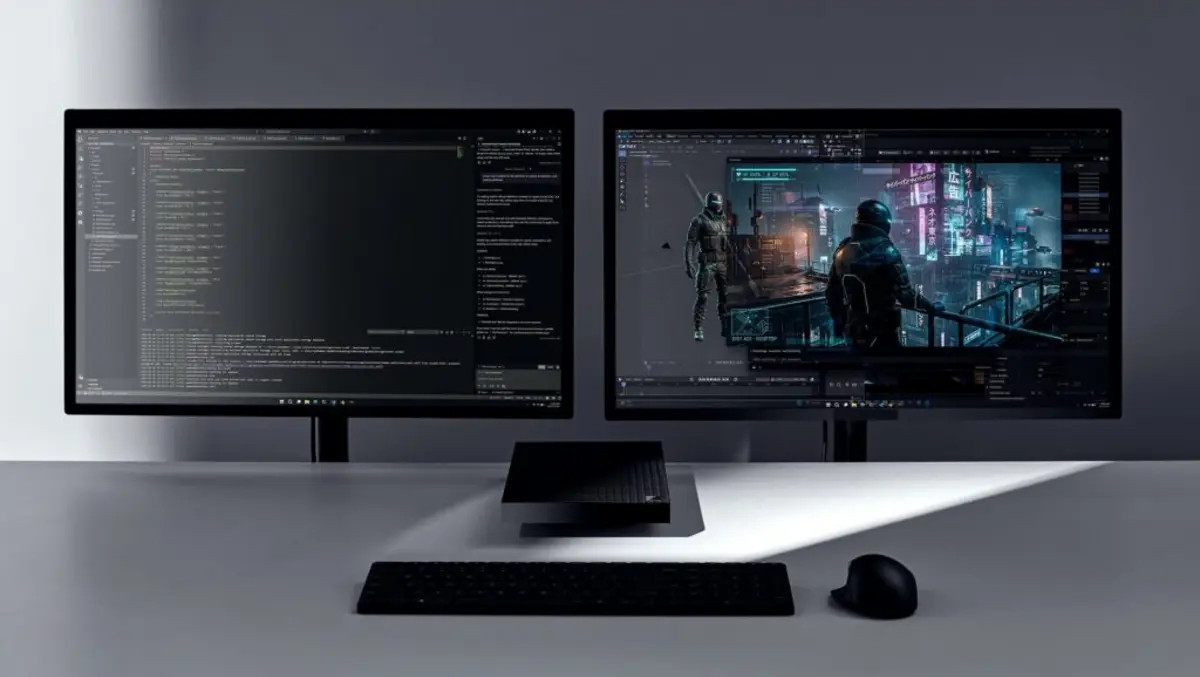
Microsoft unveils Surface RTX Spark Dev Box for developers
Wed, 3rd Jun 2026
Microsoft has introduced the Surface RTX Spark Dev Box, a new Surface category aimed at software developers.
The compact desktop is built around NVIDIA's RTX Spark superchip for local AI development on Windows. It is intended for developers who want to prototype, fine-tune and run AI models at their desks rather than rely on cloud services for every task.
The launch extends Microsoft's broader push to tailor Surface hardware to specific technical users. Alongside the recently introduced Surface Laptop Ultra, the Dev Box is an attempt to position Surface devices more directly around the needs of developers, creators and other technical professionals.
The Surface RTX Spark Dev Box offers up to 1 petaflop of AI compute and 128 GB of unified memory. Microsoft said that is enough to run models with more than 120 billion parameters and a one million-token context locally, or to fine-tune models that would otherwise require cloud GPU instances.
The hardware combines an NVIDIA Blackwell RTX GPU with an NVIDIA Grace CPU. Its aluminium chassis also acts as a heatsink, a design choice intended to support long-running training jobs, large-model inference and other sustained workloads.
Developer setup
The device ships with Windows 11 Pro and comes configured for development use. Default settings include dark mode, a simplified taskbar, no Widgets and Do Not Disturb turned on.
Developer Mode is enabled, and PowerShell 7 is the default shell. Windows Subsystem for Linux 2 is configured with GPU passthrough and CUDA support, while VS Code, GitHub Copilot, Git, Python and Node.js are installed from the outset.
That configuration reflects a wider industry shift in software development, where AI-related work often demands more local compute, larger memory pools and the ability to test models quickly without repeated cloud charges. Microsoft argues that some development tasks can be handled on the desktop, leaving cloud resources for larger or more specialised workloads.
Andrew Hill, Corporate Vice President, Surface Product, outlined that rationale in describing the product. "Software developers are some of the most ambitious makers we serve. They push devices harder, ask more of their tools and expect their environment to help define the pace of modern software creation. Development today means longer-running jobs, larger models and a growing need to prototype and iterate locally rather than paying for every cloud call. That is why we embarked on a project to build two new Surface devices designed specifically for the needs of these makers," said Hill.
Microsoft stack
Microsoft is also tying the device closely to its own software and cloud tools. AI Toolkit for VS Code supports model conversion, fine-tuning and evaluation inside the editor, while Windows ML with TensorRT and Windows Copilot Runtime provide a common surface for local inference.
Microsoft Foundry is intended to link local prototyping with production deployment, while GitHub Copilot can be used across command-line and broader development workflows on the same machine. That integration suggests Microsoft sees the Dev Box as part of a broader environment spanning hardware, operating system, developer tools and cloud services.
Security is another part of the pitch. The device is built around chip-to-cloud protections aligned with Microsoft's Zero Trust approach, including Secured-core PC architecture, BitLocker encryption and Microsoft Defender.
For business customers, the machine integrates with Entra ID and Intune, allowing IT teams to manage identity, policy and governance at scale. That may matter for development teams handling proprietary models, internal code and sensitive datasets that organisations want to keep on local hardware.
The introduction of the Surface RTX Spark Dev Box also underlines how AI workloads are influencing PC design. Rather than marketing a general-purpose desktop, Microsoft is targeting a more specialised market between conventional workstations and cloud-based AI infrastructure.
Hill framed the strategy as part of a shift in the Surface range. "With Surface Laptop Ultra and Surface RTX Spark Dev Box, we're expanding the Surface line with two products built specifically for makers. Surface Laptop Ultra is built for high-performance work that moves with you, from compiling and debugging to creative production and AI experimentation, while Surface RTX Spark Dev Box is built for the local compute developers need when models, agents and long-running workloads belong on the desk. Different form factors, same direction: giving developers the best option and more choice in where and how they build," he said.