


UK IT leaders eye observability platform consolidation
Thu, 26th Mar 2026
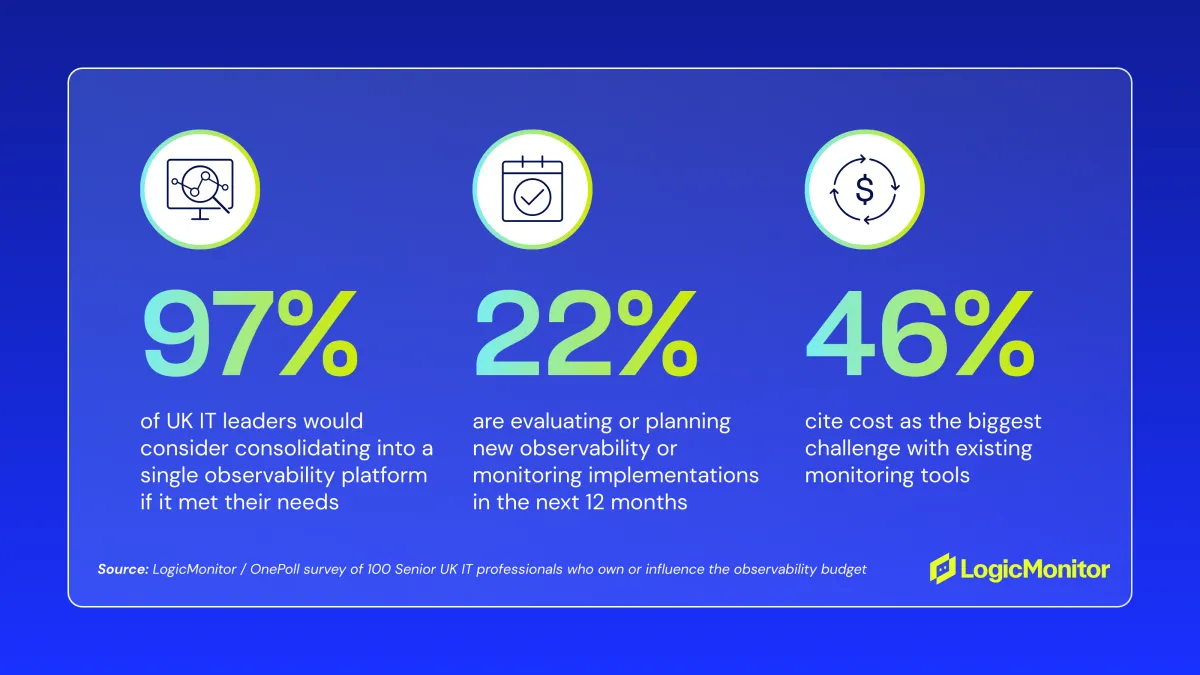
LogicMonitor has published research showing that 97% of UK IT leaders would consider consolidating observability tools into a single platform, pointing to broad dissatisfaction with fragmented monitoring setups.
The survey found that UK teams use an average of three observability or monitoring tools simultaneously, while only about one in 10 rely on a single source for operational data. Nearly half of respondents, 46%, identified cost as the biggest challenge with their current tools.
Spending plans suggest organisations are not pulling back from the category, even as they question how their systems are structured. Some 91% of UK IT leaders plan to increase observability spending over the next 12 to 24 months, while 86% expect to raise spending on monitoring tools.
Another 22% are evaluating or planning new observability or monitoring implementations within the next year, indicating that many companies are still reshaping their monitoring estates rather than settling on a stable approach.
Cost pressure
The data suggests rising operational complexity is forcing IT teams to reassess how they collect and interpret system information. Fragmented environments can duplicate licensing, create overlapping alerts and slow incident response when teams must compare signals across several products.
Cost and resource optimisation was the leading driver for AI-led observability among UK respondents, cited by 49%. Enhanced predictive analytics followed at 36%, while 34% pointed to automated remediation.
Broader IT budgets reflect similar priorities. AI ranked as the top investment area for 49% of respondents, ahead of observability at 47% and cybersecurity at 45%.
UK position
UK organisations appear to be ahead of some neighbouring European markets in their use of AI. Among senior IT decision-makers surveyed, 44% in the UK said their organisations were fully leveraging AI, compared with 14% in France, 22% in DACH and 24% in Benelux.
That gap matters because observability platforms are increasingly judged not only on monitoring functions, but also on their ability to support automation and predictive analysis. Yet the research suggests tool sprawl remains a barrier even where AI adoption is relatively advanced.
Only 6% of UK organisations made their most recent observability investment after a significant outage, compared with 10% across wider EMEA markets. That suggests UK firms are more likely to upgrade systems as part of planned technology refreshes or in response to security and compliance demands.
Operational shift
The findings point to a shift in how IT leaders view observability. Rather than treating it mainly as a way to investigate outages after the event, organisations are looking for earlier warning signs, stronger visibility and faster resolution.
This shift comes as digital infrastructure becomes harder to oversee. Hybrid estates, cloud services, applications and security layers can each generate separate streams of data, often handled by different teams using different tools. In that setting, fragmented monitoring can make it harder to build a clear picture of what is happening during an incident.
External research cited by LogicMonitor supports that view. Catchpoint's SRE Report 2025 found that 25% of businesses were operating with six to 10 monitoring tools, underlining how common tool sprawl has become.
The LogicMonitor survey covered 400 senior IT leaders across the UK, France, Benelux and DACH. The UK results suggest that while organisations are willing to keep investing, they want fewer systems and clearer operational data rather than simply adding more products to the stack.
"Many organisations are increasing their observability spend, but the underlying data remains fragmented across multiple platforms," said Karthik SJ, General Manager for AI at LogicMonitor.
"When incidents occur, teams often spend more time correlating signals across tools than resolving the issue itself. As digital infrastructure becomes more distributed and AI adoption accelerates, organisations need a unified data foundation that enables AI-driven observability to reduce noise, surface insights faster and support more resilient operations," said SJ.
"AI-first observability reduces noise, unifies insight and enables earlier intervention. But AI can only deliver meaningful outcomes when it is built on consistent, connected data. It works across a unified data foundation rather than isolated tools. The conversation is shifting from adding more tools to strengthening operational foundations, and platform consolidation will play a central role in enabling more resilient and efficient IT operations," added SJ.